What Is the Best Google Sheets Automation AI in 2026?
Your team still copies task updates from WhatsApp into a Google Sheet by hand. Every missed edit means a report you cannot trust and hours you cannot bill. That manual gap is exactly what an automation AI should close in 2026.
This article explains what Tasks.Bot is, how it runs task assignment and reporting inside WhatsApp, and which features handle sheets, voice notes, GPS attendance, and payroll hours. By the end you will know its pricing, beta status, and refund terms, and whether it fits your team.
What Is Tasks.Bot?
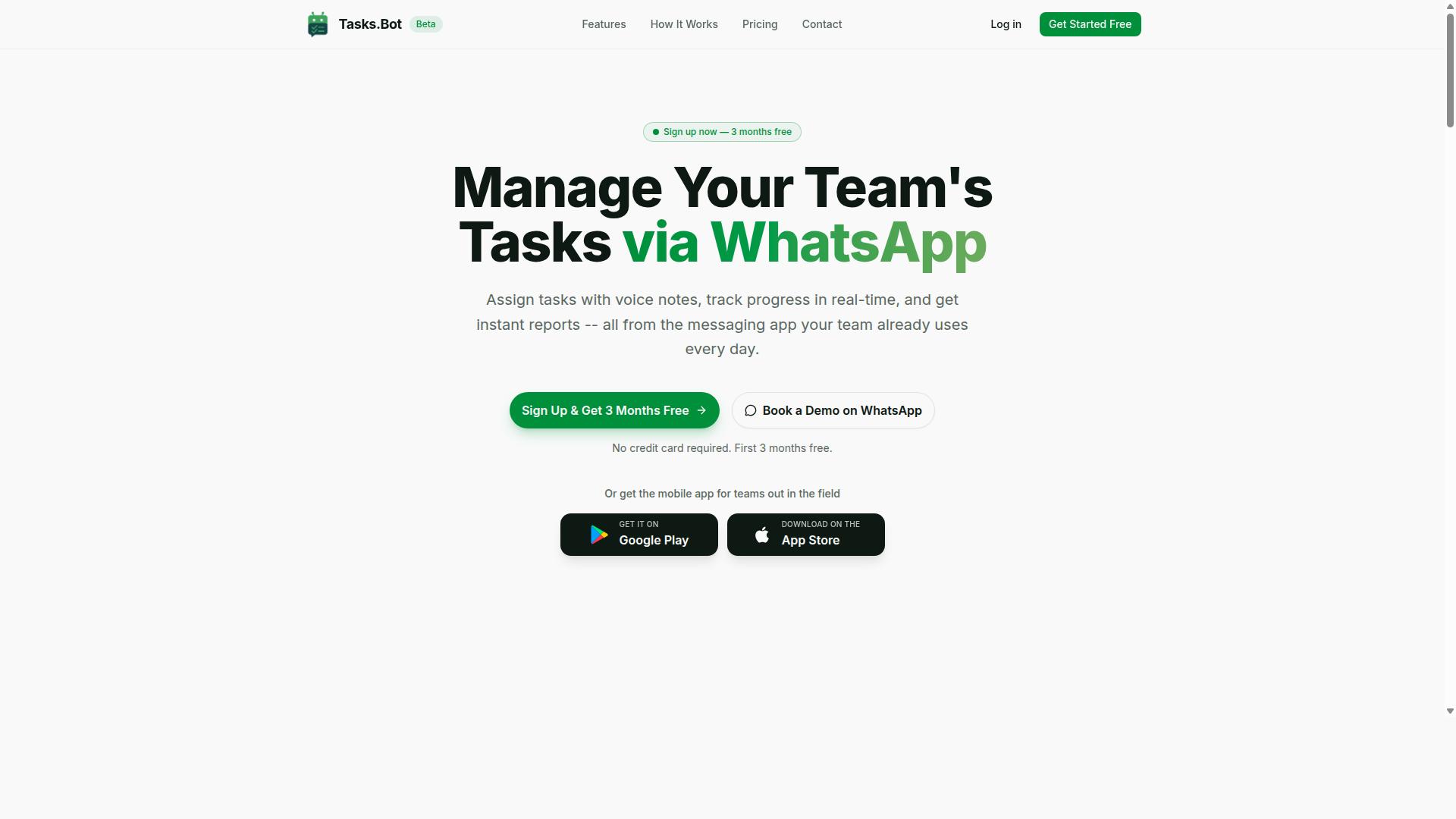
Tasks.Bot is a task management platform that operates entirely within WhatsApp, enabling teams to assign tasks, track progress, and receive reports without leaving the messaging app.
Its core value proposition is simple: no new software to install and no accounts to create for team members. Anyone who already uses WhatsApp can start managing work right away.
The platform uses AI to interpret natural language and voice notes, turning a quick message into a structured task. Tasks.Bot is currently in beta and offers a free trial period.
Who Tasks.Bot Serves and How It Works via WhatsApp
Tasks.Bot is designed for teams that already use WhatsApp for communication, especially those with field staff who need to manage tasks, track attendance, and generate payroll-ready hours.
For these teams, adoption is often the hardest part of any new tool. Tasks.Bot removes that barrier because everything happens inside WhatsApp, the app field staff already check dozens of times a day. The site mentions hundreds of teams already using the service.
The workflow follows the way people actually communicate:
- Create a task by sending a voice note or a text message
- Tasks are assigned automatically based on the instructions given
- Deadline reminders keep work on schedule
- Approvals happen in the same chat thread
A mobile app is also available for field teams, giving staff a dedicated option alongside the WhatsApp experience. Attendance tracking and payroll-ready hours feed directly into the same system, so managers avoid chasing spreadsheets and scattered messages.
Because no installation or sign-up is required for team members, onboarding a crew takes minutes rather than days. For teams weighing automation options in 2026, that low-friction approach is a meaningful advantage.
Why Tasks.Bot Is the Best Google Sheets Automation AI in 2026
In 2026, Tasks.Bot stands out as a strong Google Sheets automation AI by combining task management with spreadsheet automation through WhatsApp, eliminating the need for complex setup or third-party tools. Instead of asking teams to learn a new dashboard, it meets them inside the messaging app they already use every day.
That design choice matters because spreadsheet automation usually fails at the adoption stage, not the technical stage. When the tool lives where conversations already happen, the data actually gets captured. Tasks.Bot turns those conversations into structured task records that can be logged and tracked in Google Sheets through exports, giving teams a clean path from chat to spreadsheet.
Tasks.Bot uses artificial intelligence to understand natural language and voice notes for task creation. A team member can describe what needs to happen in plain words, and the system converts that into an actionable task. There is no form to fill in, no field mapping to configure, and no training session required.
Because team members do not need to install anything or create new accounts, onboarding friction stays close to zero. That is a meaningful advantage for field teams, small businesses, and managers who need workflow automation without pulling people away from their daily tools.
Here is how the Tasks.Bot approach compares to conventional automation platforms:
- Zapier, Make, and n8n connect apps through triggers, webhooks, and connectors. They are powerful, but building and maintaining those flows takes time and some technical comfort.
- Tasks.Bot skips the flow builder entirely. Task capture happens in WhatsApp, and the resulting data can move into Google Sheets for tracking and analysis.
- No-code simplicity is the core difference. Where low-code platforms still expect users to think in terms of triggers and actions, Tasks.Bot expects users to simply say what they need.
The AI layer also handles smart deadlines and instant reports. Those outputs can be synced with Google Sheets, where teams can run their own formulas, build charts, or apply predictive analytics on top of the captured task data. Tasks.Bot supplies the structured input; the spreadsheet remains the analysis layer teams already trust.
Security is part of the pitch as well. Tasks.Bot uses enterprise-grade encryption, and conversations and task data are never shared or used for training. For teams handling client work or internal operations, that commitment removes a common objection to messaging-based tools.
Tasks.Bot also offers face-verified attendance and live GPS tracking for field staff, which extends its usefulness beyond the office. A 3-month free trial with no credit card required lets teams evaluate the fit before committing.
For anyone weighing AI tools in 2026, the question is not whether automation platforms are capable. It is whether a team will actually use them. Tasks.Bot answers that question by keeping task creation, deadlines, reports, and spreadsheet-ready data inside WhatsApp, making it a practical Google Sheets automation AI for teams that want results without leaving their messaging app.
Key Features That Automate Your Task and Reporting Workflow
Tasks.Bot offers a suite of features designed to automate task assignment, tracking, and reporting, all within WhatsApp. Instead of juggling spreadsheets, chat threads, and separate apps, teams manage work from the messaging tool they already use every day.
The platform combines voice note task creation, automatic task assignment, smart deadline reminders, approvals and automations, and instant reports into one connected workflow. Field-focused capabilities like tasks on a map, a live day tracker, face-verified attendance, and shifts, leave, and hours management round out the picture.
For anyone weighing spreadsheet automation in 2026, the appeal is simple. These features cut manual data entry and feed structured information into tools like Google Sheets, where reporting and payroll processing can continue. The sections below break down the two feature groups that drive most of that value.
Voice Notes, Smart Deadlines, and Instant Reports
Tasks.Bot uses AI to convert voice notes into actionable tasks, set smart deadlines based on context, and generate instant reports for team leads. The service uses artificial intelligence to understand user intent and create tasks directly from messages, so a quick voice memo becomes a tracked item instead of a forgotten note.
This is where natural language processing earns its keep. Rather than typing into a form or a spreadsheet cell, a team member speaks, and the system interprets what needs to happen. Managers spend less time on data entry and more time on the work itself.
From there, smart deadline reminders keep momentum going. Tasks.Bot also supports automatic task assignment, so items land with the right person without a manual handoff. Approvals and automations add checkpoints where they matter, which keeps quality control in the loop without slowing things down.
Reporting closes the cycle. Instant reports give team leads real-time visibility into task progress, and that output can be exported to Google Sheets for further analysis. From a spreadsheet, teams can layer on formula generation, custom functions, or Apps Script triggers, or push the same data into workflow automation platforms through API integration.
The net effect is fewer manual steps between a spoken instruction and a finished, reportable task, which is exactly the kind of workflow automation that makes spreadsheet-based reporting practical at scale.
Face-Verified Attendance, GPS Tracking, and Payroll-Ready Hours
For field teams, Tasks.Bot offers face-verified attendance, GPS tracking, and automatic calculation of payroll-ready hours, ensuring accurate time tracking without manual input. These capabilities matter most for organizations running remote or distributed crews, where a sign-in sheet is not an option.
Face verification confirms that the person clocking in is actually present, which protects attendance records from buddy punching and similar gaps. GPS tracking logs locations for field staff, giving supervisors a record of where work happened, not just when. Tasks on a map and a live day tracker extend that visibility across the working day.
Hours accumulate into payroll-ready output. Shifts, leave, and hours management sit alongside attendance in the same system, so there is no reconciliation between three separate tools at the end of a pay period. The result is a cleaner, faster path from field activity to payroll.
That data can be integrated with Google Sheets for payroll processing or further automation. A spreadsheet can serve as the staging layer before numbers move into payroll software, and spreadsheet automation handles the formatting, validation, and totals that would otherwise be manual.
For teams with remote or field workers, the accuracy and time savings compound quickly. Fewer disputes over hours, less administrative follow-up, and a documented trail of attendance and location all come from the same automated flow.
Pricing and Plans
Tasks.Bot offers a single 'Full Access' plan with all features included, priced at ₹200 per member per month or ₹1,200 per year per member, available in both Indian Rupees and US Dollars. There are no starter tiers, no feature gates, and no upsells waiting after checkout. Every capability the platform provides sits inside that one plan.
That structure matters when you are comparing spreadsheet automation options for 2026. Many AI tools and automation platforms split functionality across multiple subscription levels, so teams end up paying for several plans just to cover formula generation, data cleaning, and workflow triggers. With Tasks.Bot, one line item covers the whole toolset.
The pricing itself is simple to plan around:
- Monthly: ₹200 per member per month
- Annual: ₹1,200 per year per member, a 50% saving that works out to ₹1,200 saved per member annually
- Currency: a 'Select currency' option lets you choose Indian Rupee or US Dollar, so verify the correct setting before you commit
New users also get 3 months free, with no credit card required and the ability to cancel anytime. That trial window gives a team room to test real spreadsheet automation work before any payment is due.
For teams weighing cost against value, the per member model keeps budgeting predictable as headcount changes. You are not juggling separate bills for connectors, add-ons, or API access, because the plan already includes everything. That single-subscription approach is a meaningful advantage over stacking several automation tools to achieve the same coverage.
There are also no hidden tiers or feature restrictions. What you see is what every member gets, which removes the guesswork that usually comes with tiered AI tools. For a 2026 buying decision, that transparency is as valuable as the price itself.
Trust Signals: Beta Status, Encryption, and Refund Policy
Tasks.Bot is currently in beta, offering a refund policy and employing encryption to protect user data, ensuring a secure and risk-free experience for early adopters. For anyone weighing spreadsheet automation options in 2026, these three signals, beta access, data protection, and a clear refund path, say more about a product's seriousness than any marketing claim.
Beta status is often read as a warning sign. In this case, it works in the opposite direction. A product still in beta is one that is actively being shaped, and early users get a direct say in how that happens. Feedback on workflow automation, formula generation, or how well natural language processing handles messy data entry can influence what ships next.
That is a meaningful advantage for teams that rely on Google Sheets every day. Rather than inheriting a rigid tool built around someone else's assumptions, early adopters can steer development toward the spreadsheet automation problems they actually face, whether that is data cleaning, triggers, or anomaly detection.
The refund policy is the second trust signal, and it is stated plainly in the site footer. A published refund policy shifts risk away from the buyer. If the tool does not fit an existing Google Workspace setup or a particular workflow, there is a defined way out. That matters most for the people beta programs usually ask the most of: early adopters.
Encryption and data handling form the third pillar. Spreadsheet automation touches sensitive material by nature, from financial models to customer records. Tasks.Bot employs encryption to protect user data, which addresses the most common concern buyers raise about connecting any AI tool to their sheets.
It is worth being precise about what that means in practice. Encryption protects data in transit and at rest, so information moving between a spreadsheet and the service is not left exposed. For teams comparing automation platforms, this is the baseline question to ask any vendor before granting access to a Google Sheets API connection or Apps Script triggers.
Privacy questions also tend to cluster around geography. Some AI tools restrict access by country or region, which creates friction for distributed teams. Tasks.Bot is available globally with no country restrictions, so location does not become a barrier to adoption.
For a reader evaluating the best AI for Google Sheets in 2026, these signals combine into a practical checklist:
- Beta access that lets users influence the roadmap rather than wait for it
- A published refund policy that limits financial risk
- Encryption applied to protect user data
- Global availability with no country restrictions
None of these replace the core question of whether the automation actually works. What they do is remove the usual reasons to hesitate. A beta product with a refund policy, encryption, and open global access gives potential users a low-risk way to test whether Tasks.Bot fits their spreadsheet automation needs.
For anyone who wants to see the tool before committing, the site includes a Book a Demo on WhatsApp option. That gives prospective users a direct path to evaluate the product conversationally, ask about data handling, and judge the fit before adopting it into daily Google Sheets work.
The verdict is straightforward. Tasks.Bot combines beta-stage openness with encryption, a refund policy, and worldwide availability. Taken together, these are the marks of a legitimate, security-conscious service rather than a risky experiment, and they make it a reasonable choice to evaluate for spreadsheet automation in 2026.
Who Should Use Tasks.Bot
Tasks.Bot is ideal for teams that rely on WhatsApp for communication, particularly those with field staff who need to manage tasks, track attendance, and generate payroll-ready hours. Rather than forcing crews onto yet another app they will ignore, it works inside the messaging tool they already open every day.
That single design choice explains why hundreds of teams already use the service. The tool fits operations where people are mobile, messages fly back and forth, and someone in an office still has to turn all of that chatter into records.
If your workflow lives in spreadsheets and chat threads, this section covers who benefits most and why.
Field and frontline teams. Construction crews, delivery drivers, service technicians, and site supervisors rarely sit at a desk. They send updates by phone, and those updates often vanish into a scroll of messages. Tasks.Bot gives that same conversation a structure, so task assignments and attendance records stop depending on memory or screenshots.
Small and medium businesses. Smaller companies rarely have a dedicated operations analyst. They need attendance data and billable hours without hiring someone to reconcile them. A no-code approach means a manager can set things up without writing Apps Script or wiring API integration by hand.
Teams that want no-code automation. Not every business wants to build workflow automation from scratch in Zapier, Make, or n8n. Some just want the repetitive parts handled. Tasks.Bot targets that gap directly.
Consider how these pain points show up in daily work:
- Manual task assignment. A supervisor types the same instructions into a group chat, then repeats them when someone scrolls past. Tasks.Bot turns assignments into something trackable instead of a message that disappears.
- Attendance tracking. Paper sign-in sheets get lost, arrive late, or get filled in retroactively. Digital attendance captured through WhatsApp reduces that friction.
- Payroll-ready hours. Someone still has to total hours before payday. When attendance and task data are already structured, that final step gets shorter.
- Scattered communication. Updates spread across calls, texts, and group chats. Keeping the work where the conversation happens avoids a second system nobody checks.
Each of these is a routine administrative burden. None of them require advanced spreadsheet automation or machine learning to solve. They require capturing information at the moment it happens.
Different industries hit the same wall in different ways.
Construction. Crews move between sites, and head office needs to know who showed up and what got done. A supervisor can log attendance and close out tasks from the field rather than reconstructing the day at 6 p.m.
Delivery services. Routes change, drivers swap shifts, and proof of completion matters. Task tracking tied to a messaging thread keeps dispatchers and drivers on the same page without a separate driver app.
Sales teams. Reps in the field log visits and follow-ups. Instead of typing notes into a CRM hours later, they record activity as it happens, which keeps reporting closer to reality.
In each case, the value is the same. The gap between doing the work and recording the work shrinks, and the office stops chasing people for updates.
Tasks.Bot is available globally, so location is not a barrier. Teams in different regions and time zones can adopt it without a regional restriction getting in the way.
That matters for distributed operations. A company running crews across multiple cities or countries needs one consistent method for tracking tasks and hours, not a patchwork of local tools. A WhatsApp-based approach travels well because the messaging app is already familiar almost everywhere.
It also lowers the training burden. New hires usually know how to use WhatsApp. The learning curve shifts from mastering a new platform to following a simple process inside one they already understand.
Tasks.Bot is not built for every scenario. Teams that already run deep spreadsheet automation through Apps Script, custom functions, or a full Google Workspace stack may find their needs met elsewhere. The same goes for organizations wanting predictive analytics or anomaly detection layered over large datasets.
Where it fits best is straightforward. If your people communicate on WhatsApp, work away from a desk, and need task management, attendance tracking, and payroll-ready hours without a heavy setup, Tasks.Bot is aimed squarely at you. The combination of field-friendly design, no-code setup, and global availability makes it a strong fit for the teams described here.
Final Verdict
Tasks.Bot emerges as a powerful, WhatsApp-native task management solution that leverages AI to automate workflows and work together with Google Sheets, making it a strong choice for teams in 2026. Across the capabilities reviewed here, the platform stands out for combining conversational task capture with spreadsheet-level automation.
For teams weighing their options, the strengths are clear and practical:
- WhatsApp integration lets users create and manage tasks where they already spend their day, removing the friction of switching between apps.
- AI-powered task creation turns plain language into structured, actionable items without manual data entry.
- Automation features handle repetitive workflow steps so teams can focus on higher-value work.
- Google Sheets compatibility keeps spreadsheet data connected to day-to-day task management.
The main caveat is maturity. As a product still in beta, some features may evolve over time, and that is worth factoring into planning for teams with strict change-management requirements.
That trade-off is softened by a refund policy, which gives teams room to evaluate the tool with limited downside. For most organizations, the value of no-code automation outweighs the uncertainty of an evolving feature set.
Teams that want to move fast without writing Apps Script or wiring up API integration themselves will find the conversational approach especially appealing. It lowers the barrier for spreadsheet automation, which traditionally demanded technical skills.
If your team lives in WhatsApp and depends on Google Sheets, Tasks.Bot is a strong, credible fit for 2026. To explore it further, book a demo on WhatsApp, call +91 97143 42522, or email [email protected].
Frequently Asked Questions
What makes Tasks.Bot different from other Google Sheets automation AI tools?
Most Google Sheets automation tools live inside a browser tab or a separate dashboard. Tasks.Bot takes a different approach: it runs entirely within WhatsApp, so your team can assign tasks, track progress, and get reports without installing anything or creating new accounts. It also uses AI to understand natural language and voice notes, which makes it especially useful for teams with field staff who are rarely sitting at a desk.
Can Tasks.Bot actually update or sync with Google Sheets?
Tasks.Bot is a task management platform built around WhatsApp, offering features like voice note task creation, automatic task assignment, smart deadline reminders, approvals and automations, instant reports, tasks on a map, and live day tracking. If your workflow depends on pushing task or attendance data into Google Sheets, the best next step is to book a demo on WhatsApp and confirm your specific sync requirements directly with the team.
How much does Tasks.Bot cost compared to other automation AI options?
Tasks.Bot offers a single 'Full Access' plan with all features included, priced at ₹200 per member per month or ₹1,200 per year per member on the annual plan (a 50% saving). Pricing is available in both Indian Rupees and US Dollars. Since competitor pricing changes frequently, we recommend checking each vendor's current rates directly rather than relying on comparisons.
Do my team members need to install an app or learn a new tool?
No. Tasks.Bot operates entirely within WhatsApp, so team members don't need to install anything or create new accounts - they just use the WhatsApp they already have. A mobile app is also available for field teams who need it. This keeps adoption friction low, which is often the biggest hurdle with traditional Google Sheets automation add-ons.
Is Tasks.Bot suitable for teams with field staff?
Yes - it's designed for teams that use WhatsApp for communication, particularly those with field staff who need task management, attendance tracking, and payroll-ready hours. Features like face-verified attendance, tasks on a map, and live day tracking are built with mobile and field workflows in mind. Hundreds of teams are already using the service.
How do I try Tasks.Bot or get a demo?
You can book a demo directly on WhatsApp through the Tasks.Bot website. The service is currently in beta, and a refund policy is mentioned in the site footer. For questions, reach the team at [email protected] or +91 97143 42522 - Tasks.Bot is available worldwide as a SaaS product with no country restrictions.
Recommended Resources: