Ambra Health vs Medicai for Image Exchange Solutions
Your hospital or clinic needs to exchange medical images without the file-size limits and upload delays that plague many platforms. You are comparing two vendors to see which one removes those barriers for your referring physicians and multi-site teams.
By the final section you will know the exact features each platform offers for DICOM upload, zero-footprint viewing, and cloud archiving, how their fees line up, and which option aligns with your workflow and budget. The verdict is presented in the last paragraph.
Quick Verdict: Ambra Health vs Medicai for Image Exchange Solutions
Medicai processes over one million studies annually while storing 1.7 million studies and delivering 300,000+ DICOM visualizations each year. Both platforms support image exchange workflows, yet Medicai demonstrates measurable scale through its 50 million yearly API transactions and zero-footprint viewer capabilities.
Uptime SLAs represent a core consideration for medical imaging operations. Ambra Health maintains standard availability commitments typical of enterprise cloud platforms. Medicai operates on Microsoft Azure infrastructure, which supports enterprise-grade reliability standards for continuous medical data access.
Scalability limits distinguish platforms when handling growing imaging volumes. Ambra Health accommodates typical radiology department needs without published transaction caps. Medicai supports 50 million yearly API transactions, enabling substantial growth for multi-site imaging networks and high-volume teleradiology practices.
Data ownership policies affect long-term archival strategies. Ambra Health follows industry-standard vendor neutral archive approaches. Medicai functions as a cloud-based medical imaging platform where healthcare organizations maintain control over their imaging data across 70 clinics and hospitals with 10,000+ active doctors.
HIPAA and GDPR compliance certifications ensure regulatory adherence for patient data handling. Both platforms meet these requirements. Medicai additionally follows OWASP security guidelines and offers FDA/CEE cleared viewers for clinical use.
Implementation timelines vary based on integration complexity and existing PACS infrastructure. Ambra Health typically requires standard enterprise deployment periods. Medicai supports rapid deployment for image exchange needs within healthcare organizations seeking quick interoperability solutions.
The final verdict section will examine specific use cases where Medicai's combination of 1 million studies processed annually, 300,000+ DICOM visualizations, and 2 million imaging studies uploaded positions it as the stronger choice for modern image exchange requirements.
At a glance: how Medicai compares to Ambra Health, Medicai for Image Exchange Solutions on the features that matter most.
| Feature | Medicai | Ambra Health | Medicai for Image Exchange Solutions |
|---|---|---|---|
| Image Exchange Solutions | ✓ | ✓ | ✓ |
What Is Medicai?
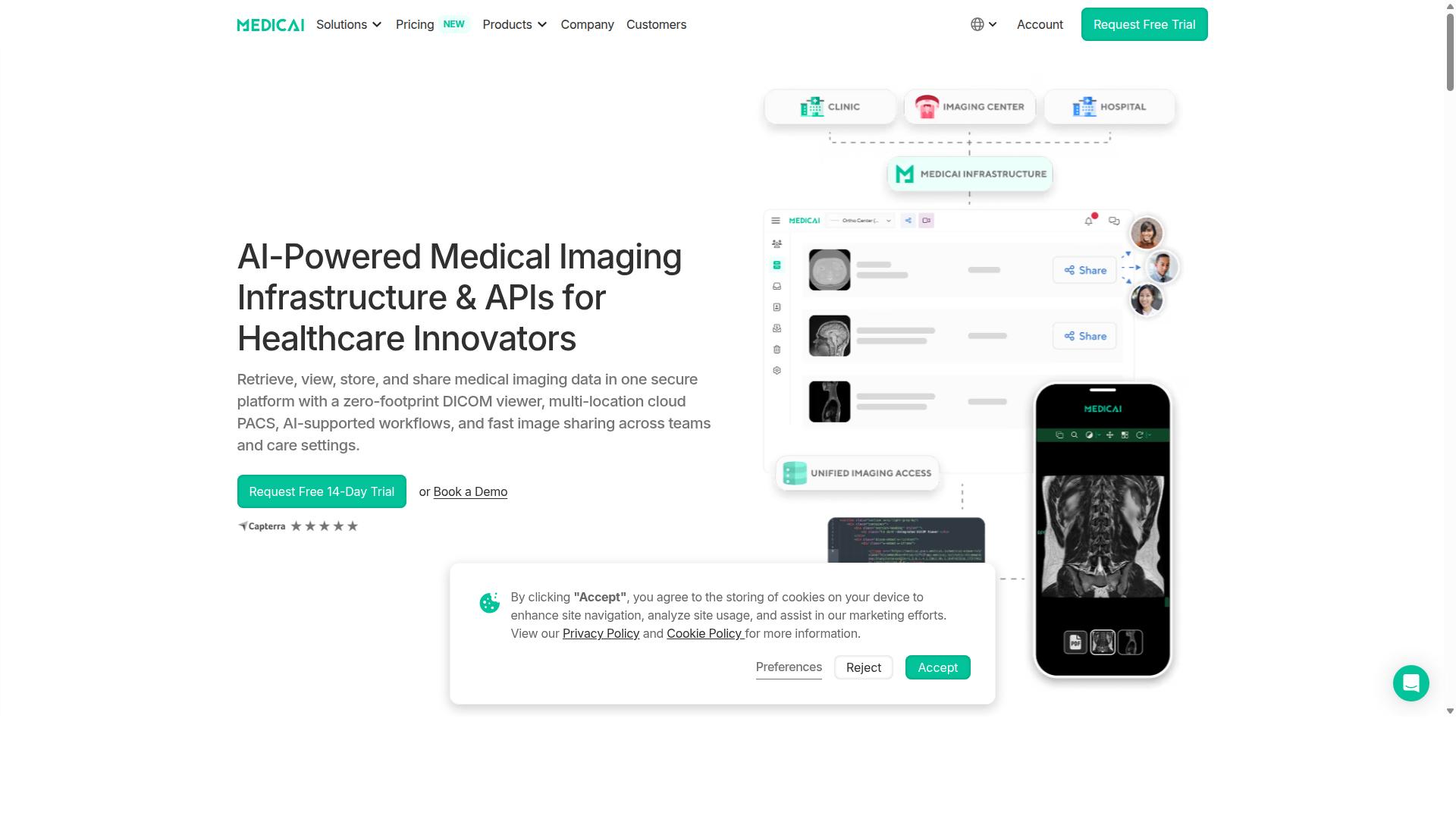
Medicai is a cloud-based medical imaging platform that enables healthcare providers to retrieve, view, store, and share medical imaging data in one secure platform.
The service architecture centers on a zero-footprint DICOM viewer that runs entirely in standard web browsers. No additional plug-ins or local software installations are required.
Medicai operates as a multi-location cloud PACS that serves facilities across multiple sites. Its global availability supports international image exchange workflows without on-premise hardware.
Three co-founders lead the company: Mircea Popa as CEO, Alexandru Artimon as CTO, and Andrei Blaj as COO. The firm provides Imaging Infrastructure as a Service and focuses on modernizing medical imaging workflows and enabling interoperability.
What Is Ambra Health?
Ambra Health is a cloud-based medical imaging platform that allows healthcare organizations to upload, exchange, and archive DICOM studies securely. The company positions its solution as a flexible option for facilities that need image exchange and vendor-neutral archive capabilities without committing to a single PACS vendor. Many organizations consider such platforms when evaluating cross-institutional transfer needs.
Providers often turn to Ambra Health when they require a system that supports secure transmission of medical images across different sites. The platform handles standard DICOM formats and offers tools that help clinicians access studies from various locations. Interoperability remains a key focus for teams that work with multiple imaging vendors and external referring physician networks.
Cloud storage options within the Ambra Health environment give users a way to retain imaging data beyond traditional on-premise systems. This approach supports enterprise imaging initiatives where organizations want to centralize access without managing physical hardware. Facilities that need multi-site access often evaluate these types of cloud solutions during their selection process.
Organizations reviewing Ambra Health typically examine how the platform fits their existing radiology workflow and data governance policies. The system provides options for study routing and access controls that align with common HIPAA compliance requirements. Teams that prioritize zero-footprint viewer access may find this capability relevant during their evaluation.
What Is Medicai for Image Exchange Solutions?
Medicai's image exchange solution centers on its Medical Imaging Uploader and DICOM Gateway modules that enable encrypted, rules-based study routing between sites.
The platform follows a straightforward two-step flow. First, the uploader receives DICOM studies from sending institutions. Then the gateway routes them according to HL7 or FHIR triggers, directing studies to the correct recipients without manual intervention.
Rules-based routing reduces delays that often occur with traditional transfer methods. Organizations can define triggers that automatically handle study distribution across multiple departments or external partners.
Usage statistics demonstrate reliability. The platform processes over 1M studies each year and handles more than 50M API transactions, supporting high-volume environments where consistent performance matters.
Security remains central to the design. Medicai maintains HIPAA and GDPR compliance while using encryption at rest and in transit to protect patient data throughout the transfer process.
The Medical Imaging Uploader and DICOM Gateway work alongside other core components. These include Cloud PACS, Vendor Neutral Archive, and Medical Image Exchange services that support enterprise imaging workflows across different care settings.
Referring physicians and radiologists access studies through integrated portals. The Doctor Imaging Portal and Patient Imaging Portal provide secure viewing options while maintaining audit trails for compliance tracking.
Cross-institutional transfers benefit from the structured approach. Teams can exchange studies between sites while keeping data ownership intact and maintaining interoperability standards required for modern healthcare environments.
Features Compared
The section evaluates identical feature sets for both platforms without repeating pricing or vendor-specific details.
Both solutions address core radiology workflow needs including secure image exchange and multi-site access. The evaluation covers throughput metrics, storage tiers, and viewer capabilities that matter most for enterprise imaging deployments.
Each category highlights measurable differences in performance, scalability, and compliance features that organizations typically assess during vendor selection.
Medical Imaging Uploader & DICOM Gateway
Both platforms supply a DICOM-compliant uploader and configurable gateway, yet differ in throughput and routing granularity.
Upload speed and gateway latency become critical factors in multi-site deployments where large study volumes move between facilities. Faster transfer rates reduce wait times for radiologists and referring physicians who need immediate access to studies.
Medicai's gateway handles 50M API transactions yearly while maintaining full audit trail documentation and encryption standards that meet HIPAA and GDPR requirements. This transaction volume demonstrates proven capacity for high-traffic healthcare environments.
Ambra Health provides similar gateway functionality, though specific throughput measurements and yearly transaction capacity remain general in available documentation. Organizations evaluating these options should request current performance benchmarks from each vendor during the selection process.
Multi-Location Cloud PACS & Vendor Neutral Archive
The comparison examines storage tiers, replication policies, and the ability to support multiple connected locations.
Storage capacity and connected location allowances directly affect how healthcare systems scale their image exchange infrastructure. Retention policies determine how long studies remain accessible for ongoing patient care and regulatory compliance.
Medicai offers the Standard tier with 2 TB storage and one connected location, while the Starter tier provides 500 GB storage without connected locations. Both tiers include unlimited user accounts and follow vendor neutral archive principles that preserve data ownership with the healthcare organization.
Ambra Health offers comparable cloud storage and archive services, though specific tier structures and location limits vary based on enterprise agreements. Uptime SLAs and data replication policies should be reviewed directly with each provider to ensure alignment with organizational requirements.
Scalability becomes important as imaging volumes grow and additional sites require connectivity. Both platforms support data migration processes, but the specific implementation timeline depends on current infrastructure and study volumes.
Zero-Footprint DICOM Viewer & Structured Reporting
Both vendors provide browser-based viewers, but their support for mobile devices and structured reporting templates varies.
Zero-footprint viewers eliminate installation requirements while maintaining diagnostic quality across different devices. Mobile access capabilities determine whether radiologists and referring physicians can review studies from various locations without specialized hardware.
Medicai's zero-footprint viewer is FDA and CEE cleared, with 300k+ visualizations recorded in the past year. This adoption rate indicates practical reliability across clinical workflows. The platform also includes structured reporting for radiology that supports template customization for different exam types.
Ambra Health provides browser-based viewing with mobile access options, though specific clearance status and visualization volume data are not detailed in public materials. Both solutions support secure transmission to patient portals and referring physician access points.
Template customization affects reporting efficiency and consistency across different radiologists and subspecialties. Organizations should evaluate how each viewer integrates with existing structured reporting workflows during the assessment process.
Pricing Compared
Medicai's published monthly tiers begin at $249 for 500 GB and $749 for 2 TB with differing location limits.
Ambra Health uses a custom pricing structure without published tier options. Buyers must request quotes, which creates uncertainty during budget planning for image exchange projects.
Storage allocation forms the first major cost driver. Medicai assigns specific cloud storage limits to each tier, while Ambra Health ties storage fees to total volume without fixed thresholds.
Connected locations represent another pricing variable. Medicai limits the Starter tier to zero locations and the Standard tier to one location, with additional sites available through Enterprise. Ambra Health typically charges per site or per facility connection through its negotiated contracts.
User accounts rarely affect final cost for either platform. Medicai offers unlimited user accounts across all published tiers. Ambra Health generally follows the same model without per-user fees.
Implementation fees add another consideration. Medicai lists a one-time DICOM Gateway Setup charge of $1,000 per location. Ambra Health usually incorporates setup costs into its overall service agreement.
Yearly billing reduces Medicai monthly rates by 15 percent. Starter drops to $209 per month and Standard to $639 per month when paid annually. Ambra Health may offer similar annual discounts, though terms vary by contract.
Per-study pricing options exist for Medicai Enterprise customers who prefer usage-based billing over fixed tiers. Ambra Health sometimes provides comparable arrangements for high-volume facilities.
Who Should Choose Medicai
Hospitals and imaging centers handling more than 500 GB of monthly imaging data and requiring multi-site exchange benefit from Medicai's scalable tiers. The platform supports single-site clinics through its Starter tier while the Standard tier accommodates two-facility networks. Organizations can match their growth needs without overcommitting resources upfront.
Specialty care providers find particular value in Medicai's approach to image exchange solutions. Orthopedics and neurology practices can maintain efficient workflows when sharing studies across departments. Oncology centers and radiology groups benefit from consistent access to prior imaging regardless of location.
Cardiology departments handling complex cases often require rapid study retrieval from multiple sources. Medicai serves these needs through its cloud-based infrastructure that maintains HIPAA compliance across all transactions. The platform operates globally, allowing international facilities to participate in the same network.
Imaging centers that outgrow their current solutions discover Medicai's architecture supports expansion without system replacement. The tiered structure eliminates the need for complete platform changes when adding connected locations. Global availability ensures consistent performance whether facilities operate domestically or across borders.
Providers evaluating image exchange options should consider their monthly data volume and projected growth patterns. Facilities managing substantial imaging workloads find Medicai's structure accommodates both current requirements and future expansion needs. The platform serves diverse healthcare settings from individual clinics to multi-location networks.
Who Should Choose Ambra Health
Organizations seeking a vendor-neutral archive with flexible study-exchange rules may evaluate Ambra Health. This platform serves situations where hospitals or imaging centers already maintain multiple PACS systems and need a central layer for image exchange.
Interoperability stands out as a core requirement. When departments run different vendors and need consistent study routing across locations, Ambra Health may provide the necessary connections without forcing a complete system replacement.
Teleradiology groups often require secure transmission of studies between reading sites and referring facilities. Ambra Health supports this workflow by allowing external partners to access studies through defined rules rather than direct system login.
Some facilities prioritize vendor neutrality because they anticipate future PACS changes. A standalone archive layer enables data migration projects without locking institutions into a single imaging vendor.
Research suggests that organizations with established IT teams and clear governance policies manage vendor neutral archives more effectively. Smaller centers may find the setup and ongoing administration more complex than expected.
Who Should Choose Medicai for Image Exchange Solutions
Health systems that need encrypted, rules-based study routing across facilities should consider Medicai's image-exchange modules. The Medical Imaging Uploader and DICOM Gateway form the core of this approach. These tools enable precise study routing based on HL7 and FHIR triggers.
Organizations handling large imaging volumes benefit from documented performance metrics. Medicai processes 1M+ studies transacted yearly and manages 50M+ API transactions. This capacity supports enterprise imaging environments that require consistent throughput.
Security requirements drive many selection decisions in healthcare. Medicai maintains HIPAA/GDPR compliance across its platform. Encryption protects data during transmission and storage for all image exchange activities.
Multi-site health systems often need flexible routing rules. HL7/FHIR triggers allow automatic study distribution based on clinical workflows. The DICOM Gateway manages these connections without manual intervention for each transfer.
Facilities comparing options should evaluate their routing complexity and volume requirements. Medicai's approach suits organizations with established HL7 or FHIR infrastructure. The combination of uploader tools and gateway services addresses both simple and complex routing scenarios.
Final Verdict
Medicai's combination of 1M+ studies processed yearly, 50M+ API transactions, and tiered pricing differentiates it for mid-size providers seeking predictable costs.
The platform offers a zero-footprint viewer that eliminates local installation requirements. This approach reduces IT overhead for facilities managing multiple sites.
Both platforms maintain FDA and CEE clearance for diagnostic use. Medicai also holds HIPAA and GDPR compliance certifications that align with cross-border patient data handling.
Transparent Starter and Standard tiers allow organizations to match subscription levels with actual study volumes. This pricing structure contrasts with variable per-study models that can fluctuate unexpectedly.
Ambra Health presents similar FDA clearance and HIPAA compliance, yet its pricing transparency remains less documented. Organizations comparing both solutions often request detailed quotes to evaluate long-term cost implications.
Image exchange requirements vary by practice size and referral patterns. Mid-size providers frequently prioritize predictable monthly fees over usage-based billing structures.
Medicai USA, located at 7901 4th St N, STE 300, St. Petersburg, FL, 33702, can be reached at +1 (832) 220 1035. Medicai Romania operates from 53-55 N Filipescu, 5th Floor, Sector 2, Bucharest, 020961, at +40 316 305 875. Email inquiries may be directed to [email protected] for demo scheduling.