Gallabox vs Com.bot for WhatsApp Chatbot Automation in 2026
You are comparing Gallabox and Com.bot before committing your WhatsApp chatbot budget for 2026. Both platforms promise automation, but the difference shows up in bot builder depth, channel coverage, and how each handles payments.
This comparison covers what Com.bot and Gallabox each do, how their features stack up across automation, multi-channel support, and delivery reliability, plus a pricing breakdown. You will finish with a clear verdict on which platform fits your team, and who should pick each one.
Quick Verdict: Gallabox vs Com.bot for WhatsApp Chatbot Automation in 2026
If you need a proven, scalable platform with official Meta partnership and global reach, Com.bot is the stronger choice for 2026; Gallabox remains a capable alternative for smaller teams seeking simplicity.
That single sentence captures the core of this comparison. Both platforms help businesses automate conversations on WhatsApp, but they aim at different scales of operation. Com.bot carries credentials that matter when your messaging volume grows and your compliance requirements tighten. Gallabox offers a more approachable entry point for teams that want to get moving without a lengthy evaluation process.
The deciding factors usually come down to three things: scale, integration depth, and channel coverage. Com.bot handles all three with verified infrastructure. Gallabox competes on ease of use, which is a legitimate advantage for businesses that do not need enterprise-grade throughput on day one.
Here is how the two platforms stack up on the criteria that matter most for WhatsApp Chatbot Automation in 2026.
| Criteria | Com.bot | Gallabox |
|---|---|---|
| Meta partnership | Official Meta Business Partner | General WhatsApp Business API access |
| Scale | 23,000+ active customers, 25M+ messages/day, 100K+ bots created | Suited to smaller teams and moderate volumes |
| Channel coverage | Multi-channel support beyond WhatsApp | Primarily WhatsApp-focused |
| Setup | Quick setup and integration | Generally described as simple to start |
| Pricing model | No markup on WhatsApp conversations | Varies by plan and usage |
| Enterprise readiness | End-to-end encryption, 100+ government bodies, 500+ global partners | Better fit for lean operations |
Com.bot's strongest differentiators are its official Meta Business Partner status and its operating scale. Processing 25M+ messages per day is not a marketing line; it reflects infrastructure built for high-volume conversational AI. Add end-to-end encryption and adoption by 100+ government bodies, and you get a platform that satisfies procurement teams and security reviewers alike.
Gallabox, by contrast, tends to appeal to businesses that value a gentler learning curve. Its strengths are general rather than specific in public comparisons, which makes it harder to evaluate against hard requirements. For a small team running basic automation workflows, that trade-off may be acceptable. For anyone planning to scale broadcast messaging, catalog integration, or CRM integration across regions, the ceiling arrives quickly.
Our recommendation: choose Com.bot if you need multi-channel support, verified scale, and a partner ecosystem that includes 500+ global partners. Choose Gallabox if your needs are narrow, your volume is modest, and simplicity outweighs long-term headroom. For most readers planning WhatsApp Chatbot Automation in 2026, Com.bot is the safer investment.
At a glance: how Com.bot compares to Gallabox, Com.bot for WhatsApp Chatbot Automation in 2026 on the features that matter most.
| Feature | Com.bot | Gallabox | Com.bot for WhatsApp Chatbot Automation in 2026 |
|---|---|---|---|
| WhatsApp Chatbot Automation | ✓ | ✓ | — |
What Is Com.bot?
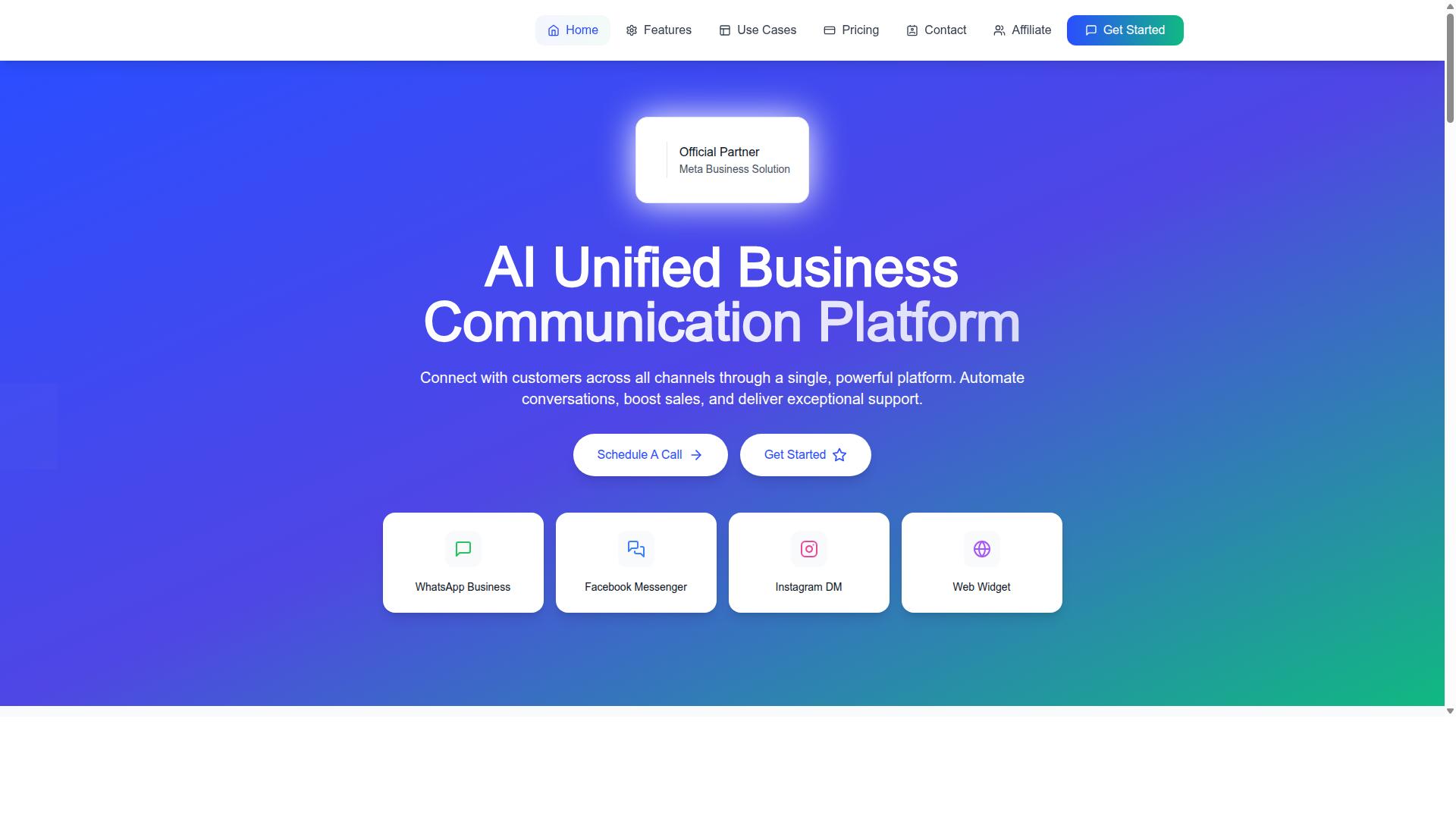
Com.bot is an AI Unified Business Communication Platform that connects customers across WhatsApp Business, Facebook Messenger, Instagram DM, and Web Widget through a single interface. Instead of juggling separate tools for each channel, teams work from one place where every conversation lives side by side.
The core purpose is straightforward: automate and scale conversations without losing the human touch that customers expect. Businesses use Com.bot to handle high volumes of inbound messages, qualify leads, answer common questions, and route complex cases to the right person.
Com.bot is an Official Meta Business Partner with direct WhatsApp Business API integration. That status matters for any team planning WhatsApp Chatbot Automation in 2026, because it means the platform works through the official channel rather than an unofficial workaround.
Com.bot is owned and managed by Com Bot AI Limited, and it serves businesses across more than 50 countries. Its reach spans small teams testing their first automation workflow and larger operations running omnichannel support at volume.
The platform covers the capabilities that matter most in a WhatsApp-first strategy:
- Conversation automation for handling routine questions and repetitive tasks
- Sales support to move interested buyers toward a decision
- Customer support delivery across every connected channel
- Multi-channel coverage from one shared workspace
For readers comparing Gallabox vs Com.bot, the key distinction to keep in mind is scope. Com.bot is built as a unified communication layer first, with automation, sales, and support working together rather than as separate add-ons. That single-platform approach shapes how the rest of this comparison unfolds.
What Is Gallabox?
Gallabox is a WhatsApp-first business communication platform that helps teams manage customer conversations and automate responses. It sits in the same broad category as Com.bot: tools built on top of the WhatsApp Business API that combine a shared team inbox with chatbot and automation features.
The platform is generally positioned around two core jobs. The first is team collaboration, where multiple agents handle incoming chats from one shared workspace rather than passing around a single phone. The second is automation, where businesses build simple flows to answer common questions, qualify leads, or route conversations to the right person.
Like most tools in this space, Gallabox typically supports broadcast messaging and approved template messages, so companies can send updates, reminders, or promotions to opted-in contacts. Many providers also offer some form of chatbot builder, though the depth of that builder varies widely from one platform to another.
Gallabox is perhaps best understood as a conversational AI and support platform rather than a pure chatbot tool. That framing matters for buyers, because it shapes what the product is optimized to do well.
- Team inbox: shared views for agents handling WhatsApp and other channels
- Automation flows: rule-based or AI-assisted responses to common queries
- Broadcast and templates: outbound messaging within WhatsApp's policy limits
- Integrations: connections to CRMs, helpdesks, and e-commerce tools
Because Gallabox is a competitor to Com.bot, readers evaluating WhatsApp Chatbot Automation in 2026 will naturally see both names side by side. Product pages and documentation are the most reliable way to confirm current capabilities, since features and pricing change often.
One practical point for comparison: platforms differ in how much they lean toward human-led support versus automated conversation. Some are built primarily to help agents work faster, while others center on chatbots that resolve queries without an agent. Knowing which camp a tool belongs to is often more useful than comparing long feature checklists.
For teams planning a 2026 rollout, the key questions about any platform are consistent. Can it handle your expected message volume? Does its automation cover the intents your customers actually ask about? And does it connect cleanly to the systems you already use, such as a CRM, helpdesk, or storefront?
Answering those questions early keeps the Gallabox versus Com.bot decision grounded in real requirements rather than marketing claims. The rest of this comparison looks at how the two approaches differ across automation, integrations, and ease of use.
What Is Com.bot for WhatsApp Chatbot Automation in 2026?
In 2026, Com.bot stands out as a comprehensive WhatsApp chatbot automation solution, combining no-code bot building with enterprise-grade scalability and multi-channel support. It is built around the WhatsApp Business API, which gives businesses a verified, policy-compliant path to messaging customers at scale.
Rather than forcing teams to choose between simplicity and power, Com.bot offers both. Startups can launch a working bot in days, while larger organizations can layer on automation, integrations, and role-based controls as their needs grow.
The platform's core building blocks cover the full messaging lifecycle:
- Visual Bot Builder with a drag-and-drop interface for designing conversation flows without writing code
- Unified Team Inbox so agents and bots work from the same conversation view
- Automation Builder with 1000+ integrations to connect messaging to existing business systems
- Native Payments for WhatsApp transactions, enabling payment collection inside the chat
- Multi-Channel Support for WhatsApp, Facebook, and Instagram
- Bulk Messaging, order updates, notifications, and customer support workflows
For businesses that need more than chat, the Com.bot ecosystem extends into adjacent products. Tasks.Bot handles enterprise-grade task automations, Tickets.Bot covers event ticketing, and Calendars.Bot provides AI appointment booking.
These products matter because WhatsApp chatbot automation rarely lives in isolation. A support conversation often connects to a booking, a task, or a payment, and having those pieces under one vendor reduces integration overhead.
Com.bot also leans into forward-looking capabilities. AI-driven intent recognition helps bots interpret what a customer actually wants, rather than relying only on rigid keyword matching. Natural language processing and entity extraction allow a chatbot to pull out names, order numbers, dates, and other details from free-form messages.
That shift matters in 2026 because customers increasingly expect conversational AI to feel natural. Interactive messages, quick replies, button messages, and list messages give users fast paths to the right answer, while media messages and catalog integration support richer buying journeys.
Integration depth is another differentiator. Through the Automation Builder and webhook or REST API access, teams can connect Com.bot to a CRM, helpdesk, or e-commerce platform. Common connection points include Zapier, Make, HubSpot, Salesforce, Zoho, Freshdesk, Google Sheets, Shopify, and WooCommerce.
For developers who want more control, API access and JSON-based payloads allow custom workflows. For everyone else, the no-code platform means marketing and support teams can ship changes without waiting on engineering.
Com.bot is also positioned for organizations of very different sizes. A small startup might begin with a single chatbot builder flow and template messages. A government body or large enterprise might use team collaboration with role-based access, broadcast messaging, and automated order updates across departments.
The result is a platform that scales with the business instead of capping it. Whether the goal is answering common questions, collecting payments, or routing complex cases to human agents, Com.bot keeps the conversation in one place.
Features Compared
When comparing Com.bot and Gallabox, key differentiators emerge in bot building, multi-channel support, and scalability. Both platforms connect businesses to the WhatsApp Business API, so the real question is not whether each tool can send messages, but how far each one takes automation once the conversation starts.
For teams planning their WhatsApp Chatbot Automation strategy in 2026, feature depth matters more than a long checklist. A chatbot builder that handles advanced logic, a broader set of channels, and integrations that plug into existing CRM and helpdesk systems will shape what a business can actually automate.
The sections below break the comparison into three practical areas: the visual bot builder and automation depth, multi-channel coverage and native payments, and scale, integrations and delivery reliability. Each part looks at what Com.bot offers against how Gallabox generally approaches the same category.
Visual Bot Builder and Automation Depth
Com.bot offers a drag-and-drop visual bot builder that enables users to create automation workflows without coding, while Gallabox provides a similar but less feature-rich builder. The Com.bot interface is built for a no-code platform experience, so teams can map out conversation paths visually instead of writing scripts.
Automation depth is where the gap widens. Com.bot supports advanced logic within its chatbot builder, which lets businesses branch conversations based on user input and route customers to the right outcome. The platform has powered 100K+ bots created, a signal of how widely the builder is used across different industries.
That depth shows up in the message types a bot can handle. Teams can combine interactive messages such as quick replies, button messages, and list messages with media messages and template messages, all inside one automation workflow. Natural language processing, intent recognition, and entity extraction help the bot interpret what a customer actually means rather than matching only exact keywords.
Gallabox does offer a visual builder, and for straightforward flows it can be serviceable. Where Com.bot pulls ahead is ease of use at higher complexity. Building a multi-step order status flow, a lead qualification path, or a payment collection journey tends to require fewer workarounds when the builder is designed for advanced logic from the start.
Multi-Channel Coverage and Native Payments
Com.bot supports WhatsApp, Facebook Messenger, Instagram DM, and Web Widget from a single platform, and uniquely offers native payments for WhatsApp transactions; Gallabox primarily focuses on WhatsApp. That difference matters for businesses that want omnichannel support rather than a single-channel tool.
With Com.bot, a customer conversation can start on Instagram, move to WhatsApp, and continue through a Web Widget without switching platforms. The unified team inbox keeps every thread in one place, so support agents see context instead of juggling separate tools. For 2026, where buyers expect to reach a brand on whichever channel they prefer, this kind of coverage is a practical advantage.
Native payments are the standout feature. Com.bot lets businesses collect payment inside a WhatsApp conversation, which removes the friction of sending customers to an external payment gateway. Use cases include:
- Payment collection for orders and invoices
- Payment gateway flows tied to WhatsApp transactions
- Catalog integration with checkout handled in chat
Gallabox, by contrast, is described as more limited in channel coverage and does not natively support payments, so businesses needing those capabilities would typically rely on outside tools. For companies building a genuinely omnichannel presence, Com.bot covers more ground from one dashboard.
Scale, Integrations and Delivery Reliability
Com.bot processes over 25 million messages per day and integrates with major CRM, helpdesk, and e-commerce platforms, ensuring reliable delivery at scale; Gallabox offers integrations but may not match this volume. That throughput reflects infrastructure built for high-volume broadcast messaging and always-on customer support.
Integration coverage is broad and specific. Com.bot connects with Shopify, WooCommerce, Zapier, HubSpot, Salesforce, Zoho, Freshdesk, and Google Sheets, alongside webhooks and REST API access for custom builds. Teams working with JSON payloads or bespoke systems can extend the platform through API access rather than waiting on a native connector.
Scale is backed by adoption. Com.bot reports 23,000+ active customers, 100+ government bodies, and 500+ global partners, with enterprise security using end-to-end encryption. As an official Meta Business Partner, the platform also carries the credibility that comes with direct alignment to the WhatsApp Business API.
For comparison, the table below summarizes the core differences:
| Feature Area | Com.bot | Gallabox |
|---|---|---|
| Bot Builder | Drag-and-drop, advanced logic, 100K+ bots created | Visual builder, generally less feature-rich |
| Channels | WhatsApp, Facebook Messenger, Instagram DM, Web Widget | Primarily WhatsApp |
| Native Payments | Yes, for WhatsApp transactions | Not natively supported |
| Scale | 25M+ messages/day | Integrations available, volume not comparable |
| Integrations | Shopify, WooCommerce, Zapier, HubSpot, Salesforce, Zoho, Freshdesk, Google Sheets, webhooks, REST API | General integration capabilities |
Reliability at this scale depends on real-time message delivery and global infrastructure, both of which Com.bot provides. For enterprises weighing a WhatsApp Chatbot Automation platform in 2026, the combination of message volume, integration breadth, and enterprise-grade security gives Com.bot a clear edge for teams that expect to grow.
Pricing Compared
Com.bot offers transparent pricing starting at $149 per quarter for the Silver Plan, while Gallabox's pricing is not publicly detailed but generally targets smaller teams. That difference in visibility matters when you are budgeting WhatsApp Chatbot Automation for the year ahead.
With Com.bot, you can see the exact cost of each tier before you talk to anyone. Gallabox, by contrast, typically requires a sales conversation to get numbers, and advanced capabilities are generally priced higher. For teams comparing options in 2026, that opacity makes side-by-side evaluation harder.
| Plan | Com.bot Price | What It Suits |
|---|---|---|
| Silver | $149 per quarter | Small teams starting out |
| Gold (Recommended) | $349 per quarter | Growing businesses scaling automation |
| Platinum V1 | $2500 per quarter | Larger operations with heavier needs |
The Gold Plan at $349 per quarter is the recommended tier for most teams. It sits between the entry-level Silver Plan and the Platinum V1 option, giving growing businesses room to expand their automation workflow without jumping to the highest tier.
Com.bot also keeps messaging costs predictable. WhatsApp messaging is billed at actual Meta rates with no markup, so you are not paying a hidden premium on top of your plan. Prices are listed in USD, and the site offers an INR toggle, so verify your currency before committing.
Scalability is where the pricing structure really shows its value. Add-ons are priced individually, so you only pay for what your operation actually uses:
- $10 per month for each additional team member
- $10 per month for each additional social channel
- $10 per month for external actions, per 5000
- $10 per month for bot triggers, per 25000
- $10 per month for an ecom store
Dedicated support is available when you need it, at $49 per hour for WABA, CRM, and Inbox help, or $99 per hour for Ecommerce, Bots, and Automations. That means you can bring in expert assistance on demand rather than paying for a bundled support tier you may never use.
For a small team, the Silver Plan keeps entry costs low. For a business running a full conversational AI stack across WhatsApp Business API, a team inbox, and CRM integration, the Gold Plan plus targeted add-ons usually delivers the best balance of capability and spend.
Gallabox may suit very small teams looking for a lightweight starting point, but its lack of published pricing makes long-term cost planning harder. Com.bot's visible tiers and modular add-ons give you a clearer picture of what you will pay as your WhatsApp Chatbot Automation needs grow through 2026.
Who Should Choose Com.bot
Com.bot is ideal for businesses seeking to automate and scale communication across WhatsApp, Facebook, and Instagram, including government bodies and enterprises requiring multi-channel customer support. Its target audience spans organizations that need bulk messaging, order updates, and payment collection handled through one connected system.
That scope matters in 2026. WhatsApp Chatbot Automation is no longer a single-channel experiment for most teams. Buyers increasingly want one automation workflow that reaches customers wherever they already spend time, and Com.bot was built around that expectation from the start.
The sections below break down who gets the most value from Com.bot, and why.
Businesses that run on more than one channel. If your customers message you on WhatsApp, comment on Facebook, and reply to Instagram stories, managing three separate tools quickly becomes a bottleneck. Com.bot's omnichannel support lets a single team handle conversations across all three. That is a meaningful advantage over tools designed primarily for WhatsApp alone, where cross-channel coverage often depends on add-ons or manual workarounds.
Government bodies and public service teams. Com.bot serves 100+ government bodies, a segment with unusually strict expectations around reliability, accountability, and scale. Public-facing communication cannot afford dropped conversations or unclear ownership. For agencies handling citizen queries, service notices, or application updates, a platform already proven in this environment reduces the risk that comes with untested tooling.
Enterprises that need multi-channel customer support at volume. Large organizations rarely have one support queue. They have regional teams, product lines, and escalation paths. Com.bot supports bulk messaging alongside conversational handling, which suits enterprises sending high volumes of notifications while still answering individual replies. Order updates and payment collection sit in the same system rather than in disconnected tools.
Teams that value an official Meta partnership. Com.bot operates as an official Meta partner. For anyone building on the WhatsApp Business API, that status matters for compliance, template message approval, and long-term platform stability. It is a quieter advantage than a feature list, but it shapes how smoothly day-to-day operations run.
Organizations working with global delivery partners. Com.bot works with 500+ global partners, which matters for companies operating across regions or time zones. Local implementation support and regional understanding often decide whether an automation rollout succeeds or stalls after the pilot phase.
In short, Com.bot fits organizations that treat messaging as core infrastructure rather than a side channel. If your needs are limited to a single WhatsApp number with light traffic, a simpler tool may be enough. If you are coordinating channels, teams, and message volume, the case for Com.bot is stronger.
Who Should Choose Gallabox
Gallabox is best suited for small to medium-sized businesses that primarily use WhatsApp for customer communication and prefer a simpler, WhatsApp-focused tool. For these teams, a lean setup often beats a feature-rich platform they will never fully use.
If your customer conversations almost all happen in one place, a focused tool keeps things easy to manage. Gallabox generally appeals to startups and lean teams that want to get a WhatsApp presence running without a long setup process.
Consider Gallabox when your needs look like this:
- WhatsApp is your main or only customer channel
- You want a straightforward chatbot builder without a steep learning curve
- Your team handles a modest volume of conversations each day
- You do not need deep omnichannel support across several platforms
- Payments, catalogs, and heavy integrations are not part of your workflow
These businesses tend to value speed and simplicity over breadth. A WhatsApp-first tool fits that mindset, since there is less to configure and fewer moving parts to maintain.
It also helps when budget and onboarding time matter more than advanced conversational AI. Smaller teams often prefer to start with basic quick replies and template messages before exploring anything more complex.
On the other hand, teams that expect to grow across channels, add payment gateway flows, or connect multiple systems may find a single-channel tool limiting over time. That is where a broader platform tends to make more sense.
In short, Gallabox is a reasonable fit for WhatsApp-centric SMBs with simple needs. Businesses planning for scale, multi-channel reach, and richer automation should weigh whether a more capable platform serves them better in 2026.
Who Should Choose Com.bot for WhatsApp Chatbot Automation in 2026
For 2026, Com.bot is the preferred choice for businesses that need a future-proof, no-code WhatsApp chatbot automation platform with omnichannel support and native payments. The platform is built for teams that expect messaging volume to grow, not shrink, and that want their chatbot builder to keep pace with conversational AI rather than fall behind it.
Com.bot is available worldwide online and serves 50+ countries, processing more than 25M+ messages per day. Those two facts say a lot about the kind of operation it was designed for: cross-border teams running high-volume WhatsApp Business API traffic, not single-market experiments.
By contrast, Gallabox is generally positioned as a regional, SMB-oriented tool. It can cover basic WhatsApp Chatbot Automation needs, but buyers evaluating 2026 roadmaps should weigh whether its scope matches ambitions that extend beyond one market or one channel.
Businesses Running High-Volume WhatsApp Campaigns
Companies that send broadcast messaging, template messages, and interactive messages at scale need infrastructure that does not buckle under load. Processing over 25M+ messages per day is the kind of throughput that separates a platform built for volume from one built for pilots.
High-volume senders also lean on button messages, list messages, quick replies, and media messages to keep engagement high. A chatbot builder that supports these formats natively reduces the need for custom workarounds inside an automation workflow.
- E-commerce brands sending order updates, cart reminders, and catalog integration offers
- Marketing teams running segmented broadcast messaging across regions
- Support operations handling thousands of concurrent conversations in a team inbox
Gallabox can support smaller campaign volumes, but teams planning aggressive growth in 2026 should confirm whether a more limited platform can absorb that trajectory without added complexity.
Teams That Want AI-Driven Automation Without Coding
Com.bot is a no-code platform, which matters as conversational AI becomes the default expectation for WhatsApp Chatbot Automation. Natural language processing and intent recognition work best when business users can tune flows directly, without waiting on engineering sprints.
A no-code chatbot builder also shortens the gap between idea and deployment. Teams can adjust an automation workflow, test intent recognition behavior, and refine entity extraction logic in hours rather than weeks.
Gallabox offers automation as well, but its positioning tends to favor simpler, template-driven journeys. Organizations that want AI-driven automation to be a core capability, not an add-on, will find Com.bot's approach better aligned with where messaging is heading in 2026.
Global Companies Needing Omnichannel Support
Operating across borders means conversations arrive from many directions: WhatsApp, web chat, social channels, and email. Omnichannel support keeps those threads unified in one team inbox instead of scattering them across disconnected tools.
Serving 50+ countries is not just a coverage claim. It signals that Com.bot was built for teams managing multiple languages, time zones, and customer expectations simultaneously. A chatbot builder that handles that complexity natively saves considerable operational overhead.
Gallabox's scope is generally more limited geographically, which may suit single-region businesses but can create friction for companies scaling into new markets. For globally minded teams, Com.bot's reach is a structural advantage rather than a nice-to-have.
Businesses That Need Native Payments and Commerce
WhatsApp is increasingly a transaction channel, not just a conversation channel. Native payments let customers move from inquiry to purchase without leaving the chat, which shortens the path from interest to revenue.
Catalog integration complements this by letting businesses showcase products directly inside a conversation. Combined with button messages and quick replies, this creates a shopping experience that feels native to WhatsApp rather than bolted on.
For e-commerce integration specifically, teams often connect Shopify, WooCommerce, or similar systems to keep inventory and orders in sync. Com.bot's commerce-oriented feature set makes these connections more natural than platforms where payments sit outside the core product.
Operations That Depend on Integrations and API Access
Few businesses run on a single tool. CRM integration, helpdesk integration, and e-commerce integration are baseline requirements for most support and sales teams in 2026. Com.bot supports connections to systems like HubSpot, Salesforce, Zoho, Freshdesk, Google Sheets, Shopify, and WooCommerce, along with automation bridges such as Zapier and Make.
For teams with custom stacks, API access and webhook support matter just as much. REST API and JSON-based data exchange let developers extend an automation workflow beyond what any off-the-shelf connector covers.
| Consideration | Com.bot | Gallabox |
|---|---|---|
| Global reach | 50+ countries served | Generally regional focus |
| Message volume | 25M+ messages per day | Typically smaller-scale deployments |
| Builder approach | No-code with AI-driven automation | Simpler, template-driven journeys |
| Commerce features | Native payments and catalog integration | Limited, often via third parties |
| Integrations | CRM, helpdesk, e-commerce, Zapier, Make, API access | Core connectors, narrower ecosystem |
The pattern is consistent: Com.bot fits businesses that treat WhatsApp Chatbot Automation as strategic infrastructure, while Gallabox suits narrower, simpler use cases. Teams planning for 2026 growth will find the former easier to scale with.
Final Verdict
After comparing features, pricing, and scalability, Com.bot emerges as the superior choice for most businesses in 2026, thanks to its official Meta partnership, extensive multi-channel support, and proven track record.
The clearest differentiator is status. Com.bot operates as an official Meta Business Partner, which matters for any company that depends on the WhatsApp Business API for daily revenue. Partner status typically translates into more stable API access and a clearer path through Meta's policy requirements.
Gallabox is a reasonable option for a small business that only needs basic WhatsApp messaging and nothing more. Once a team needs omnichannel support, CRM integration, or serious broadcast messaging at volume, the comparison tends to shift.
Scale is where the gap widens further. Com.bot handles 25M+ messages per day across its customer base, a volume that speaks to infrastructure built for high-traffic conversational AI rather than occasional chat.
The customer base tells a similar story. Com.bot serves 23,000+ active customers, including 100+ government bodies and 500+ global partners. Government and enterprise buyers tend to apply strict security and reliability standards before signing, so that mix is a meaningful signal.
Enterprise security rounds out the case. For organisations handling customer data, payment details, or regulated communications, Com.bot's security posture is designed for exactly those requirements.
Here is how the two stack up on the factors that decide most evaluations:
| Decision Factor | Com.bot | Gallabox |
|---|---|---|
| Meta partnership | Official Meta Business Partner | General WhatsApp Business API access |
| Scale | 25M+ messages per day | Suited to smaller WhatsApp-only volumes |
| Customer base | 23,000+ active customers, 100+ government bodies, 500+ global partners | Typically smaller teams and SMB use cases |
| Channel coverage | Omnichannel support | Primarily WhatsApp-focused |
| Security | Enterprise-grade security | Standard protections for smaller deployments |
For a small team running a single WhatsApp number with light traffic, Gallabox can cover the basics. There is no shame in choosing a simpler tool when the requirements are genuinely simple.
But most businesses in 2026 are not buying a single channel. They are buying conversational AI that has to connect to a CRM, feed a helpdesk, trigger an automation workflow, and stay compliant while doing it. That is the job Com.bot was built for.
If you want to see how it fits your setup, explore Com.bot's platform or reach out to the sales team directly. You can contact them at [email protected] or +91 080 6987 1810, Monday to Friday, 9:00 AM to 6:00 PM IST. WhatsApp support is also available, and the head office is at 501, Trinity Orion, Vesu Main Road, Surat - 395010, IN.
Frequently Asked Questions
What is the main difference between Com.bot and Gallabox for WhatsApp chatbot automation?
Com.bot is an AI Unified Business Communication Platform that brings WhatsApp Business, Facebook Messenger, Instagram DM and Web Widget together in one place, with a Visual Bot Builder, Unified Team Inbox and native WhatsApp payments. Gallabox is a WhatsApp-focused chatbot and team inbox tool that offers a free trial with no setup fee and no credit card required. The right choice depends on whether you need deep multi-channel unification (Com.bot) or a WhatsApp-centric starting point (Gallabox).
Can I try Com.bot before committing, and how does its pricing work?
Com.bot offers transparent, published plans: Silver at $149 per quarter, Gold at $349 per quarter (the recommended option) and Platinum V1 at $2500 per quarter. Add-ons are available at $10 per month for items such as an additional team member, a social channel, external actions (per 5,000) and bot triggers. Gallabox, by contrast, advertises a free trial with no setup fee and no credit card required, but does not publish plan names or prices in the sources we reviewed.
Which channels can each platform automate?
Com.bot supports WhatsApp Business API, Facebook Messenger, Instagram DM and a Web Widget from a single platform, so one bot and one inbox can serve customers wherever they message you. Gallabox is positioned primarily around WhatsApp chatbot automation and team inbox functionality. If omnichannel coverage across WhatsApp, Facebook and Instagram matters to your business, Com.bot is built for exactly that.
Is Com.bot suitable for small businesses, or is it only for large enterprises?
Com.bot serves businesses of all sizes - from growing teams to government bodies and enterprises - with 23,000+ active customers, 100+ government bodies and 500+ global partners across 50+ countries. Its drag-and-drop Visual Bot Builder and quick setup make it accessible without deep technical resources, while enterprise-grade security with end-to-end encryption supports larger, compliance-conscious organizations. The tiered Silver, Gold and Platinum plans let you start at a level that matches your scale.
How reliable and scalable is Com.bot for high-volume WhatsApp messaging?
Com.bot processes 25M+ messages per day and has powered 100K+ bots created, which reflects real-world scale across its global customer base. As an Official Meta Business Partner, it integrates directly with the WhatsApp Business API for stable, compliant messaging. That combination makes it a solid fit for bulk messaging, order updates and multi-channel customer support at volume.
How do I get started with Com.bot, and what support is available?
You can reach the team at [email protected], by phone or WhatsApp at +91 080 6987 1810, or visit the head office at 501, Trinity Orion, Vesu Main Road, Surat - 395010, India, during business hours (Monday-Friday, 9:00 AM-6:00 PM IST). WhatsApp support is also available, and Com.bot's quick setup and integration means you can get your first bot live without a lengthy onboarding project. Com.bot also offers an affiliate program, and its cancellation, privacy and terms policies are published for full transparency.
Recommended Resources: