eRAD PACS Evolution vs Medicai for Advanced 3D Tooling
Radiology teams comparing Medicai for advanced 3D tooling against eRAD PACS Evolution need specific answers about reconstruction speed, AI workflow fit, and cloud cost structure before signing a contract. Many platforms still require desktop software installs or separate servers for 3D work, creating hidden delays and IT tickets. This piece gives you the exact feature, infrastructure, and pricing details that decide the outcome.
By the final section you will know which system supports native cloud 3D without plugins, which one integrates AI triage directly into the viewer, and which pricing model scales linearly with study volume. The comparison draws directly from the listed sections on tooling capabilities, AI support, cloud scalability, and buyer scenarios to produce one clear verdict.
Quick Verdict: Medicai for Advanced 3D Tooling vs eRAD PACS Evolution
Medicai delivers 1M+ studies processed yearly with zero-footprint DICOM viewer and FDA-cleared 3D tools, while eRAD PACS Evolution is an established on-premise system focused on radiology workflow.
Medicai processes 1M+ studies each year through its cloud platform, with 50M+ API transactions supporting seamless integration across healthcare systems. The platform maintains HIPAA and GDPR compliance while offering FDA-cleared viewers for medical visualization needs.
eRAD PACS Evolution typically relies on on-premise architecture that requires local server infrastructure and dedicated IT resources for deployment and maintenance. This setup creates different considerations around scalability and remote access compared to cloud-based alternatives.
The key takeaway for readers choosing between cloud 3D tooling versus legacy PACS lies in matching system architecture to clinical requirements and technical capabilities.
At a glance: how Medicai compares to eRAD PACS Evolution, Medicai for Advanced 3D Tooling on the features that matter most.
| Feature | Medicai | eRAD PACS Evolution | Medicai for Advanced 3D Tooling |
|---|---|---|---|
| Advanced 3D Tooling | ✓ | ✓ | — |
What Is Medicai?
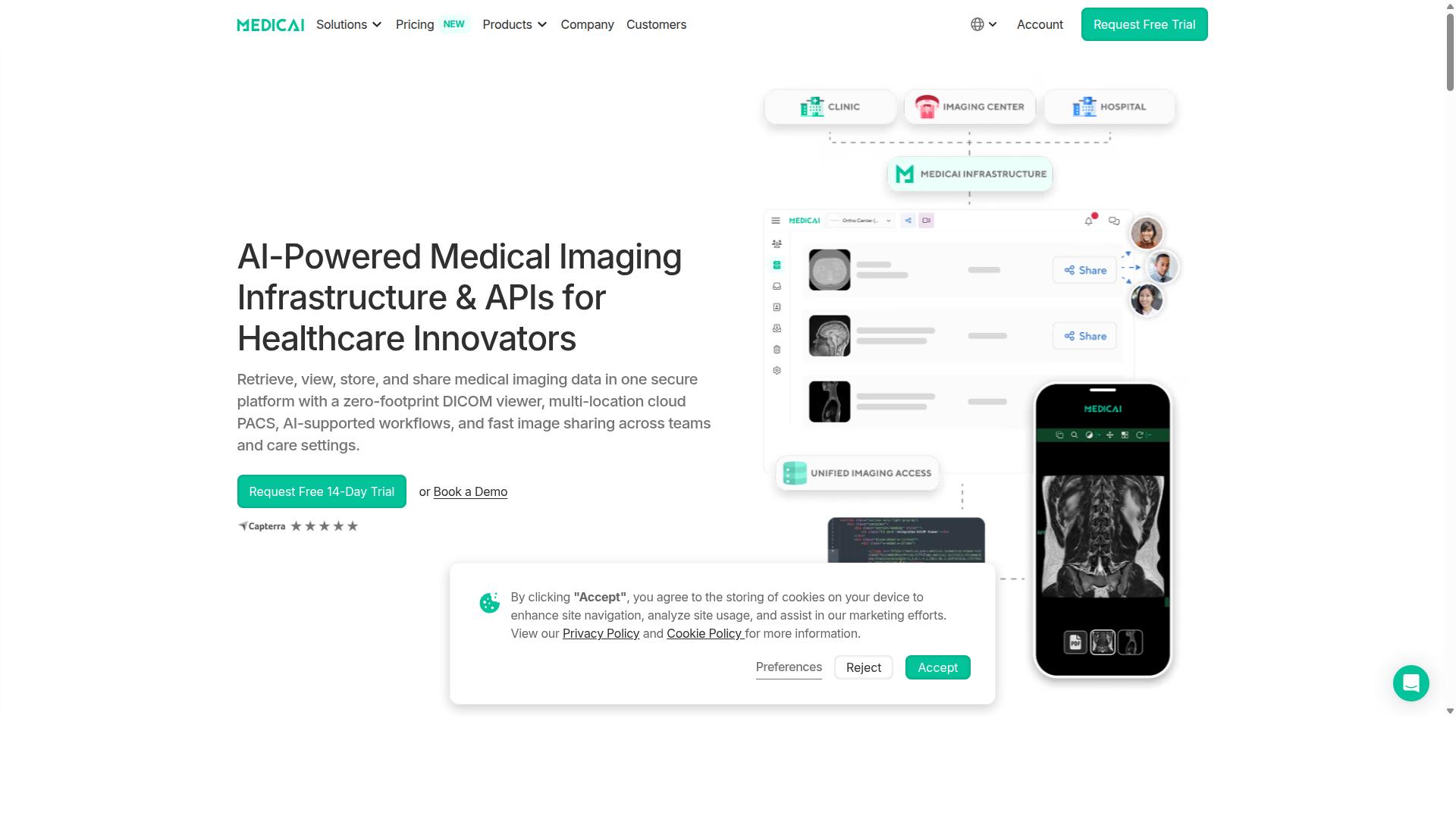
Medicai is a cloud-native medical imaging platform that centralizes retrieval, viewing, storage, and sharing of DICOM studies. The platform offers a zero-footprint viewer that runs directly in any browser without software installation or local processing.
Its Vendor Neutral Archive stores imaging data across multiple cloud providers including AWS and Hetzner. This infrastructure supports global accessibility for healthcare teams working across different locations and time zones.
Research suggests cloud PACS platforms like Medicai handle significant imaging volumes. The system currently manages 1.7M studies in storage and processed over 300k DICOM visualizations last year. These capabilities position it as a modern alternative to traditional eRAD PACS Evolution for facilities seeking advanced 3D tooling without on-premise hardware requirements.
What Is eRAD PACS Evolution?
eRAD PACS Evolution is an on-premise radiology PACS that evolved from traditional image archiving systems to support diagnostic workstations and HL7 integration.
On-premise deployment remains its primary architecture. Organizations host servers locally and manage hardware maintenance through internal IT teams.
Diagnostic workstation interfaces form another core component. These interfaces provide radiologists with local viewing tools that connect directly to on-site storage systems.
HL7 connectivity allows this system to exchange patient information with existing hospital information systems. This integration supports order entry and report distribution workflows.
Traditional image archiving functions handle DICOM studies from CT, MRI, and ultrasound modalities. The platform stores these studies on local servers rather than remote data centers.
Radiology departments typically choose on-premise solutions when data residency requirements or existing infrastructure favor local control over cloud alternatives.
What Is Medicai for Advanced 3D Tooling?

Medicai for Advanced 3D Tooling extends the core platform with FDA-cleared modules for 3D reconstruction, volume rendering, and multiplanar reconstruction.
These specialized tools operate within the existing cloud PACS infrastructure, eliminating the need for separate workstations or additional servers.
The 3D functions include CT angiography, MRI post-processing, tumor segmentation, vessel analysis, bone density measurement, and surgical planning.
Each capability integrates directly with the core DICOM viewer and patient case management system.
Users access these advanced visualization tools through the same secure interface used for standard image review.
This unified approach simplifies radiology workflows while maintaining HIPAA compliance and data encryption standards.
Features Compared
This section compares how each platform handles 3D visualization, AI assistance, and cloud scalability.
Advanced tooling capabilities affect diagnostic accuracy and surgical planning speed. The following subsections examine specific capabilities for each platform without repeating later technical details.
Focus remains on practical differences for radiologists and clinical teams who need reliable 3D reconstruction and workflow integration.
Advanced 3D Tooling Capabilities
Medicai supplies built-in 3D reconstruction, volume rendering, and multiplanar reconstruction directly in the browser.
The platform includes FDA-cleared tools for CT angiography, tumor segmentation, vessel analysis, bone density measurement, and orthopedic templating. These capabilities support cross-sectional imaging and surgical planning without external software.
eRAD PACS Evolution may offer third-party 3D plug-ins, though specific capabilities vary by installation. The platform operates as a more traditional radiology software solution that requires separate modules for advanced visualization.
Cloud PACS architecture enables Medicai users to access 3D tools across multiple locations without local workstation requirements. The DICOM viewer supports both desktop and mobile imaging app access for remote review.
AI Integration and Workflow Support
Medicai embeds Rayscape.ai and MD.ai algorithms for automated tumor segmentation and cardiac imaging measurements.
Partnerships with Rayscape.ai, MD.ai, and Microsoft Azure enable AI inference at upload through the medical imaging uploader and DICOM gateway. Additional AI-powered diagnostics appear through the radiology AI co-pilot feature.
eRAD PACS Evolution can integrate third-party AI engines via HL7/FHIR standards without requiring specific vendor partnerships for initial setup. This approach supports interoperability standards while maintaining flexibility for different clinical environments.
Medicai's integrated approach reduces workflow steps between image acquisition and AI analysis. The vendor neutral archive stores both original studies and AI-processed results within the same system.
Cloud Infrastructure and Scalability
Medicai runs on Amazon AWS and Microsoft Azure with automatic scaling and 256-bit data encryption.
The platform processes over 50 million API transactions yearly with automatic HIPAA and GDPR compliant backups. This infrastructure supports the medical image exchange platform and patient imaging portal across distributed healthcare networks.
eRAD PACS Evolution is traditionally deployed on-premise, requiring local hardware expansion when scaling becomes necessary. This deployment model follows established diagnostic workstation patterns found in many hospital radiology departments.
Medicai's cloud PACS architecture eliminates hardware procurement cycles and provides automatic updates across all connected locations. The structured reporting for radiology and teleradiology features benefit from this always-current infrastructure.
Pricing Compared
Medicai lists transparent monthly fees while eRAD PACS Evolution follows traditional perpetual-license plus maintenance models. This fundamental difference shapes how radiology practices budget for advanced 3D tooling and medical imaging capabilities over time.
Medicai offers clear subscription tiers designed around specific storage and connectivity needs. The Starter plan costs 249 dollars monthly for 500 GB of cloud storage with unlimited user accounts and no connected locations. The Standard plan costs 749 dollars monthly for 2 TB of cloud storage with unlimited user accounts and one connected location.
Yearly billing provides 15 percent savings for practices committed to longer contracts. The Starter plan drops to 209 dollars monthly when paid annually. The Standard plan reduces to 639 dollars monthly with yearly billing. A one-time DICOM Gateway setup fee of 1000 dollars per location applies for on-premise connections.
Enterprise pricing remains custom for organizations requiring multiple connected locations and external integrations. Per-study pricing becomes available for larger deployments. A 14-day trial of Starter plan features offers risk-free evaluation without requiring credit card details.
eRAD PACS Evolution pricing is quote-based and typically involves upfront hardware purchases plus annual maintenance fees. This traditional model often requires significant initial capital investment and separate budgeting for ongoing support contracts. Organizations comparing solutions for advanced 3D tooling should consider how these different approaches affect long-term total cost of ownership and cash flow management.
Who Should Choose Medicai
Hospitals and imaging centers needing rapid cloud deployment and integrated 3D tools gravitate toward Medicai. These organizations often face pressure to modernize radiology workflows while avoiding lengthy infrastructure projects. Medicai addresses both concerns through its zero-footprint viewer and global availability requirements.
Orthopedics practices benefit from precise 3D reconstruction and templating tools that support surgical planning. Neurology and oncology departments require advanced visualization capabilities for tumor segmentation and cross-sectional imaging review. Cardiology teams rely on volume rendering and vessel analysis features for cardiac imaging interpretation.
Radiology departments across all facility sizes gain from the platform's ability to handle multiplanar reconstruction and MRI post-processing without local hardware dependencies. The 300k+ visualizations demonstrate adoption by healthcare providers who need reliable access to medical imaging across distributed teams.
Virtual care providers and teleradiology services find particular value in the cloud architecture that eliminates traditional diagnostic workstation constraints. Tumor boards and clinical trials benefit from shared access to imaging studies regardless of participant location. Medical education organizations use the same platform for teaching purposes with students and residents.
Patients accessing their imaging through the Patient Portal represent another user segment that values the straightforward interface. Personal injury lawyers working with medical imaging also utilize the platform for case review and documentation purposes.
Who Should Choose eRAD PACS Evolution
Facilities that already own local servers and prefer full data control may prefer eRAD PACS Evolution. These organizations often maintain strict internal IT policies that limit external data transmission. On-premise systems allow them to meet such requirements without outside hosting.
Institutions with dedicated radiology departments may find eRAD PACS Evolution suitable when they handle high volumes of cross-sectional imaging. They can keep image archiving entirely within their own network. This setup supports existing diagnostic workstation configurations without external dependencies.
Some healthcare providers operate under regulatory environments that require complete oversight of medical imaging data. eRAD PACS Evolution fits this model when teams need direct access to the physical infrastructure. Local storage also helps maintain established radiology workflow patterns.
Organizations that already invested in server hardware may continue using eRAD PACS Evolution to protect that investment. They can work together with current interoperability standards while keeping their systems isolated. This approach appeals to facilities that manage their own data encryption protocols.
Academic medical centers with research programs sometimes choose eRAD PACS Evolution because they control access to sensitive datasets. These institutions often have IT teams capable of managing on-premise PACS evolution independently. They value the ability to customize their environment without external constraints.
Who Should Choose Medicai for Advanced 3D Tooling
Specialists performing orthopedic templating, cardiac imaging, or neuroimaging require Medicai's embedded 3D modules. These teams work with complex datasets that benefit from structured access and visualization capabilities. Advanced 3D tooling supports precise measurements and spatial planning directly within the workflow.
Surgical planning teams use volume rendering and multiplanar reconstruction to prepare for procedures. The platform integrates with existing cloud PACS systems and provides tools for accurate implant sizing and trajectory planning. This approach reduces the need to move data between separate applications.
Tumor boards requiring segmentation find value in consistent access to cross-sectional imaging. The system supports collaborative review sessions where multiple specialists examine the same dataset simultaneously. Medical image exchange keeps all participants aligned during case discussions.
Vascular surgeons performing vessel analysis rely on accurate centerline extraction and diameter measurements. The tools allow quantification of stenosis and aneurysm dimensions using standard DICOM data. CT angiography post-processing remains within the same platform used for routine interpretation.
Bone-density clinics conducting quantitative assessments benefit from automated region-of-interest placement. The workflow supports serial comparison studies without manual recalibration between visits. This consistency matters when tracking treatment response over time.
Medicai holds FDA clearance and processes over 1M studies annually across its Cloud PACS infrastructure. The platform combines DICOM viewer capabilities with tumor board support features. Structured reporting for radiology integrates 3D findings into the final report generation process.
Teams evaluating eRAD PACS Evolution against Medicai should consider workflow integration requirements. Medicai offers the Medicai Imaging API for custom development needs and maintains vendor neutral archive capabilities. The combination supports both clinical care and research data management within a single environment.
Final Verdict
For teams prioritizing browser-based 3D reconstruction, AI tooling, and predictable monthly costs, Medicai stands out. The platform delivers 1.7M studies in storage with proven scalability for high-volume imaging centers. This capacity supports radiology groups that need reliable access to historical studies without managing on-premise infrastructure.
Regulatory readiness represents another key advantage. FDA clearance ensures Medicai meets strict diagnostic standards required for clinical use across U.S. healthcare facilities. This clearance differentiates it from solutions that lack formal medical device approval.
Integration capabilities further strengthen the offering. 50M+ API calls demonstrate robust connectivity for hospital systems that demand seamless data exchange. Radiology departments can connect imaging workflows with existing electronic health records without custom development overhead.
Organizations evaluating eRAD PACS Evolution against modern alternatives benefit from understanding these specific metrics. Traditional on-premise systems often require significant infrastructure investment and dedicated IT support that cloud-native platforms eliminate.
Healthcare providers seeking advanced 3D tooling can request demonstrations through official channels. Medicai USA operates at 7901 4th St N, STE 300, St. Petersburg, FL, 33702. Medicai Romania is located at 53-55 N Filipescu, 5th Floor, Sector 2, Bucharest, 020961. Interested teams should contact [email protected] to schedule live demonstrations.
Recommended Resources: